Furnace capacity is quoted in BTU per hour, and there are two of those numbers on every unit.
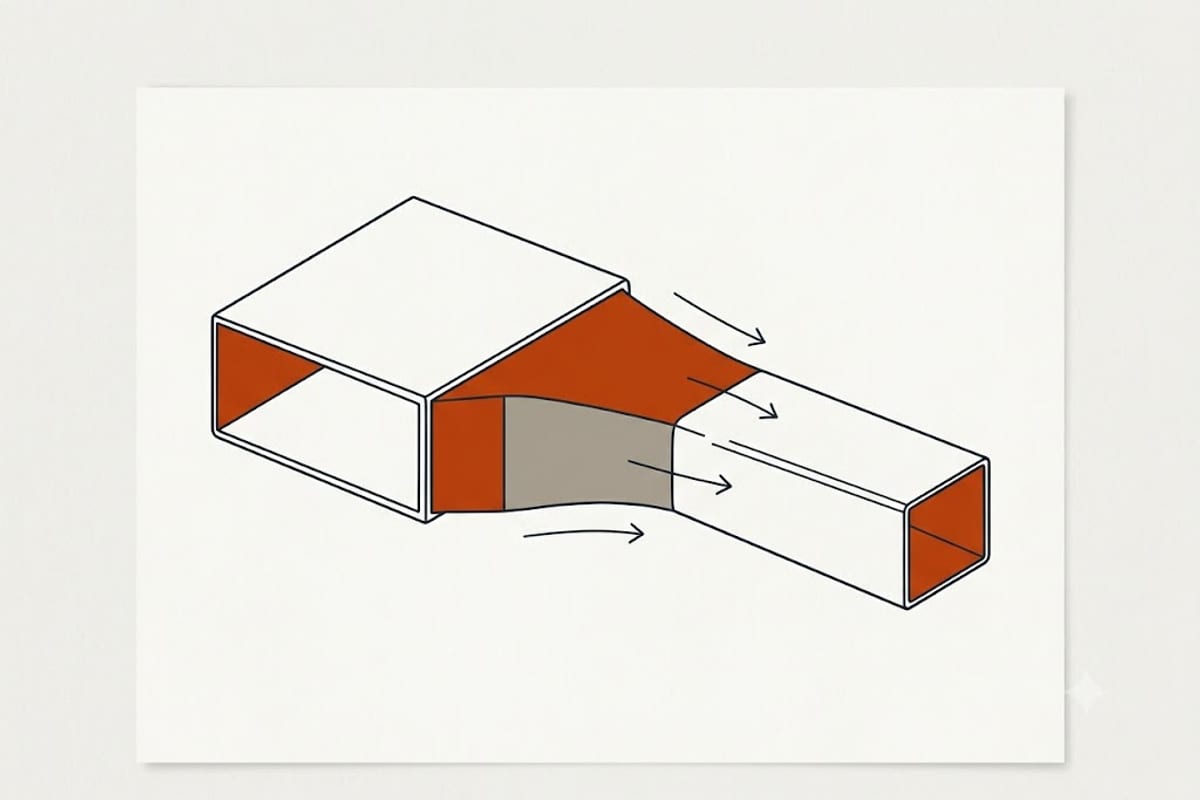
Input and output
Input is the fuel energy the burner consumes — the number in the model name.
Output is the heat actually delivered to the house, which is input multiplied by the AFUE rating.
A 100,000 BTU input furnace at 80% AFUE delivers 80,000 BTU/h. The same input at 96% AFUE delivers 96,000.
Sizing is done against output. A quote that matches a load calculation to an input figure has oversized by whatever the efficiency loss is.
The starting rule
Heating requirement runs roughly 30 to 60 BTU per square foot of output, and the range is entirely climate and envelope:
| Climate | BTU/h output per sq ft |
|---|---|
| Hot (Gulf, Southwest) | 25–30 |
| Mixed (mid-Atlantic, Southeast) | 30–40 |
| Cold (Midwest, Northeast) | 40–50 |
| Very cold (Upper Midwest, Northern Plains) | 50–60 |
A 2,000 sq ft house in a cold climate is therefore roughly 80,000–100,000 BTU/h of output, which is a 100,000–125,000 BTU input furnace at 80% AFUE, or about 85,000–105,000 input at 96%.
What moves it
Insulation and air sealing, which dominate the heating load far more than they dominate the cooling load. A well-sealed modern house can need half what an equivalent 1950s house needs.
Window area and U-factor. Heating load cares about U-factor, not SHGC — the reverse of cooling.
Ceiling height, since the load is volumetric.
Basement or crawl space, conditioned or not.
Duct location. Ducts in an unconditioned attic or crawl lose heat continuously.
Why oversizing is a problem here too
An oversized furnace reaches setpoint quickly and shuts off. The consequences differ from an oversized air conditioner but they are real:
Short cycling, which wastes the fuel spent bringing a cold heat exchanger up to temperature each start.
Temperature swings, since the house is heated in bursts.
Cold spots, because short blower runs do not distribute heat evenly.
Wear on the igniter, the inducer and the heat exchanger, which sees a thermal cycle on every start.
A drafty feeling, because the blower runs at full output for a short time rather than gently for a long one.
Sizing tolerance
ACCA Manual S guidance for furnaces allows more headroom than for cooling — commonly up to 140% of the calculated heating load, because a furnace has no humidity role and because recovery from setback matters.
That is still a limit, and it is routinely exceeded. Systems at 200% of load are common in houses where each replacement matched the last.
The two-stage and modulating answer
A two-stage furnace runs at roughly 65% of capacity most of the time and steps up in severe weather.
A modulating furnace varies its firing rate continuously, often from 40% to 100%, and holds a steady output matched to the load.
Both dramatically reduce the consequences of a sizing error and both produce noticeably steadier temperatures. In a house where the existing furnace is oversized and the ductwork suits it, this is often the most practical improvement available.
The number that settles it
A Manual J load calculation, which for heating is a more straightforward computation than for cooling — there is no latent load and no solar gain to account for.
It will almost always come out below the rule of thumb, and well below whatever is currently installed. That gap is the size of the mistake being carried forward each time a furnace is replaced by matching the old one.