AFUE — Annual Fuel Utilization Efficiency — is the fraction of fuel energy that becomes useful heat in the house over a heating season.
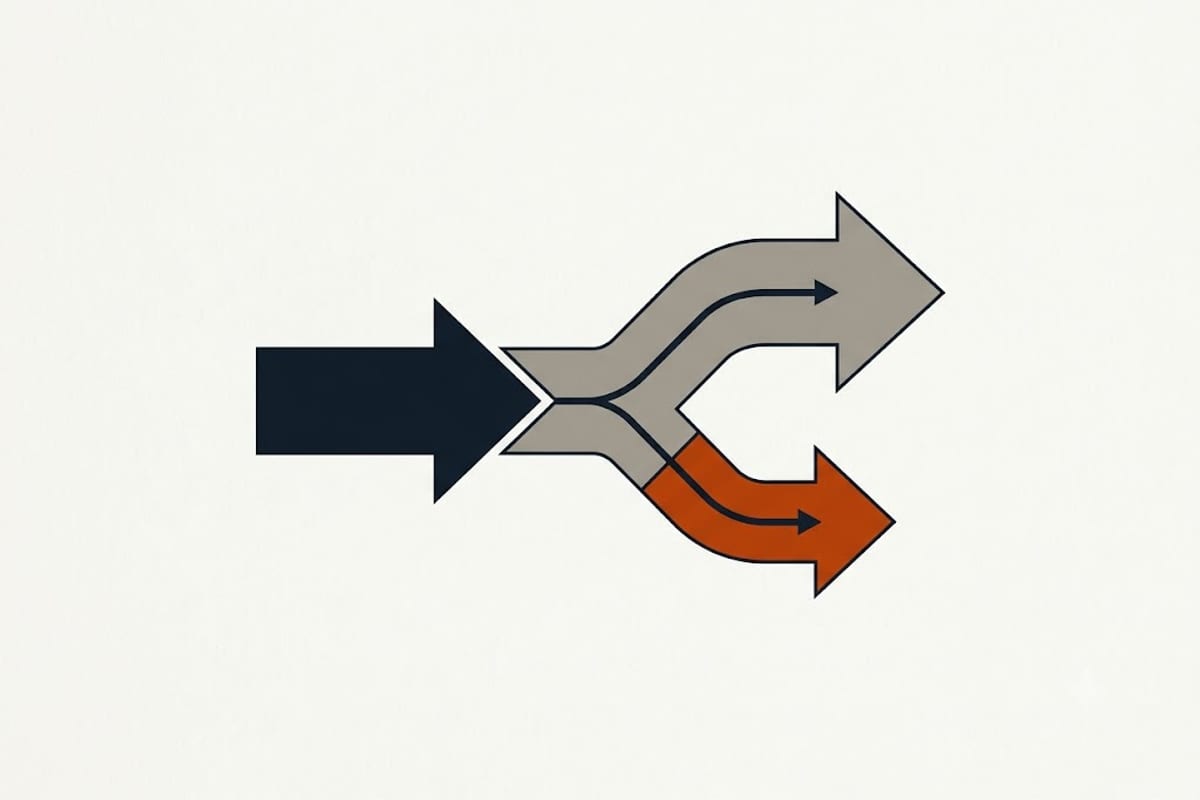
The two families
Non-condensing, roughly 80–83% AFUE. Combustion gases leave hot enough to rise up a conventional flue. Around 20% of the fuel energy goes up the chimney, much of it as latent heat in water vapour.
Condensing, 90–98% AFUE. A second heat exchanger cools the flue gases far enough that the water vapour in them condenses, releasing its latent heat into the house. The exhaust is cool enough to vent through PVC and it produces acidic condensate that must be drained.
The jump between the families is a change in machine, not a tuning.
What the difference is worth
From 80% to 96% AFUE, fuel use falls by about 17% — not 16 percentage points, because the comparison is of ratios: 80/96 means the higher-efficiency unit needs 83% of the fuel for the same heat.
Applied to a heating bill, that is the annual saving. Multiply by the years of expected service and compare against the price difference plus the venting change.
Why the answer is regional
In a cold climate with a long heating season, the savings are large and the payback is usually comfortably within the furnace's life. Several northern jurisdictions effectively require condensing equipment.
In a mild climate with a short season, the same percentage applies to a much smaller bill, and the payback can exceed the equipment's life.
Fuel price matters directly. Where gas is cheap the savings are smaller in dollars; where it is expensive they are larger.
The venting cost
Converting from a non-condensing to a condensing furnace changes the venting completely.
The old metal flue is abandoned, and PVC or polypropylene runs to a sidewall or roof termination. A condensate drain is needed, sometimes with a neutraliser and sometimes with a small pump.
If an existing chimney also serves a water heater, removing the furnace from it leaves the water heater on an oversized flue, which can cause condensation and draft problems in the chimney. That has to be addressed, usually by relining or by replacing the water heater with a power-vented or tankless unit.
This is real money and it is a legitimate reason for two quotes to differ substantially.
The rule that is changing
The Department of Energy has finalised a standard raising the minimum efficiency for non-weatherised gas furnaces to 95% AFUE, effective for units manufactured from late 2028.
The practical consequence is that the 80% option has a limited remaining life. For a furnace being replaced now, it is worth knowing that the venting conversion will eventually be required anyway.
What AFUE does not measure
Electricity use by the blower, which is significant over a season. An ECM blower motor uses substantially less than the older PSC type, and that saving is not in the AFUE figure at all.
Duct losses, which can waste a larger fraction than the difference between the two efficiency families. A 96% furnace feeding leaky attic ducts delivers less to the house than an 80% furnace feeding sealed ducts inside the envelope.
Distribution and comfort, which is where two-stage and modulating operation earns its money regardless of the AFUE number.
The order that gives the best return
Seal the ducts. Air-seal and insulate. Calculate the load. Size the furnace to the reduced load. Then decide the efficiency tier with the remaining budget.
Reversing that order buys a high-efficiency furnace to heat a house that did not need to lose that much heat in the first place.