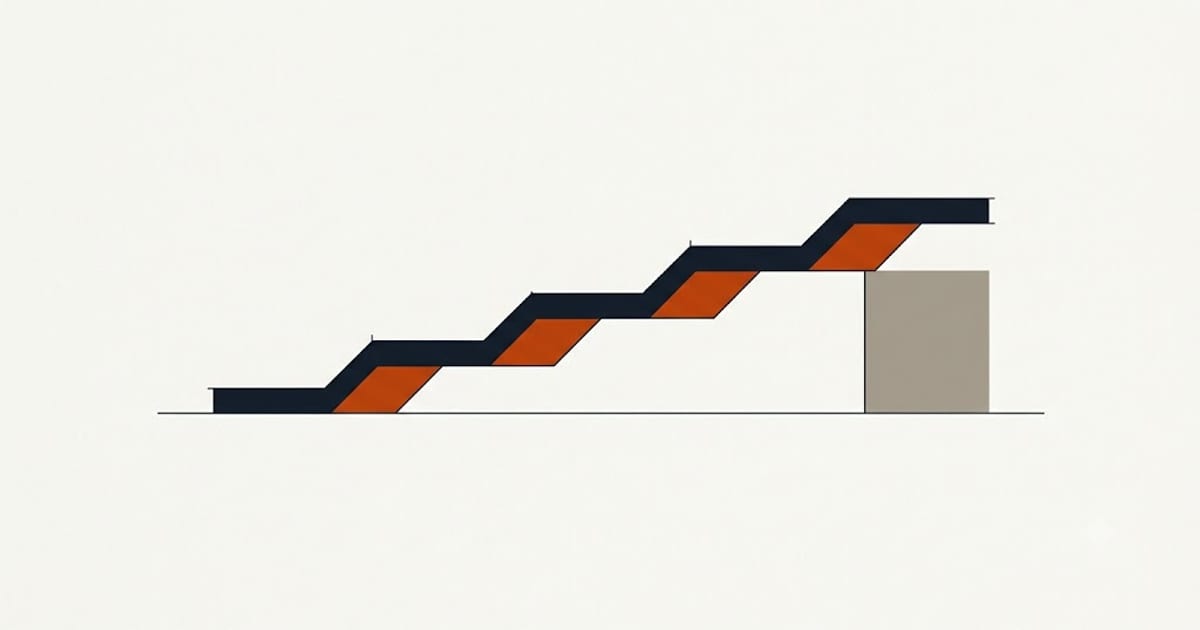
Furnace input sizes run in steps — commonly 40,000, 60,000, 80,000, 100,000 and 120,000 BTU/h — and the installed price does not rise in proportion.
What scales and what does not
Equipment cost scales, roughly, within a product line.
Labour does not. Removing an old furnace and setting a new one takes about the same time regardless of its input. The venting, the gas connection, the electrical, the condensate, the plenum transitions and the permit are all essentially fixed.
Since those fixed items are commonly half the total, a step up in size changes the total by considerably less than the BTU ratio suggests.
Why that is a problem
Going a size larger is cheap on a quote and expensive over twenty years of temperature swings, short cycling and premature igniter failures.
The contractor who rounds up faces no sales resistance and eliminates any risk of a callback in a cold snap. The incentives all point one way, and that is the mechanism by which so much of the housing stock ended up with furnaces at twice their calculated load.
Understanding this is the reason to insist on a load calculation rather than accepting the bigger option because the difference looks small.
What moves the total far more than size
Efficiency family. 80% to 96% brings a venting conversion, condensate provision and often chimney work for the orphaned water heater. This is usually the largest single difference between two quotes.
Staging. Single-stage to two-stage to modulating is a bigger step than any single size increment.
Blower motor type, which usually travels with the staging.
Duct correction, which is real work and a real improvement.
Access. A tight crawl space or attic installation costs more in labour than a basement.
Region. Labour rates and permit costs vary widely.
Reading a per-BTU figure
A quote expressed as dollars per thousand BTU is a poor comparison tool, precisely because the fixed costs do not scale. A small furnace always looks expensive by that measure and a large one cheap, which says nothing useful about either.
Compare total installed price for a specified system with the same scope on both quotes.
Where the money is best spent
For most houses, in this order: correct sizing, then duct correction and sealing, then envelope improvements, then staging and blower type, then AFUE.
The last item is what quotes are usually argued about, and it is the one with the least effect on whether the house is comfortable.
The one place a bigger number is worth paying for
Not capacity — modulation range. A modulating furnace that turns down to 40% of its input covers a mild day and a severe one with the same machine.
That is what people are actually trying to buy when they buy extra capacity, and it is available directly rather than by oversizing.
Timing
Spring and autumn pricing is better than January pricing, manufacturer rebates cluster in the off-season, and the crews are less rushed.
For a furnace that is old but working, that difference is usually larger than the gap between any two sizes on the quote.
Input, output, and the number on the box
Furnaces are named by input. The heat that reaches the house is input times AFUE.
A 100,000 BTU furnace at 80% delivers 80,000; the same input at 96% delivers 96,000. So an efficiency upgrade at the same nominal size is also a capacity increase of about 20%, and if the old furnace was already adequate the new one should usually be a size smaller rather than the same size.
This is one of the most common sizing errors in a like-for-like replacement, and it happens silently because the model number looks familiar.
Incentives reward efficiency, not capacity
Federal credits and utility rebates are tied to AFUE thresholds and to equipment type, not to input BTU.
That makes an incentive an argument for a better furnace and never for a bigger one. An oversized qualifying furnace is still oversized, and the temperature swings it produces are not refundable.
Thresholds are revised annually, so check the qualifying level for the year of installation rather than the year of the quote.